Excel

When Excel stops being enough

Excel isn't the problem. The problem is that the process has grown, and the file hasn't.

The reality

Excel isn't bad, it just stops working at some point

Excel is a great tool — as long as it's one person, one file, and a simple process. The problem isn't that Excel is bad, but that the business grows while the spreadsheet stays a spreadsheet: it doesn't validate data, doesn't remember which version is the real one, and doesn't ask anyone before letting an error slip through.

The familiar symptoms

Do you recognize yourself here?

If you recognize yourself in at least two or three of the things below, you're probably already at the point where Excel is more of a burden than a help.

Before — scattered across 4 apps
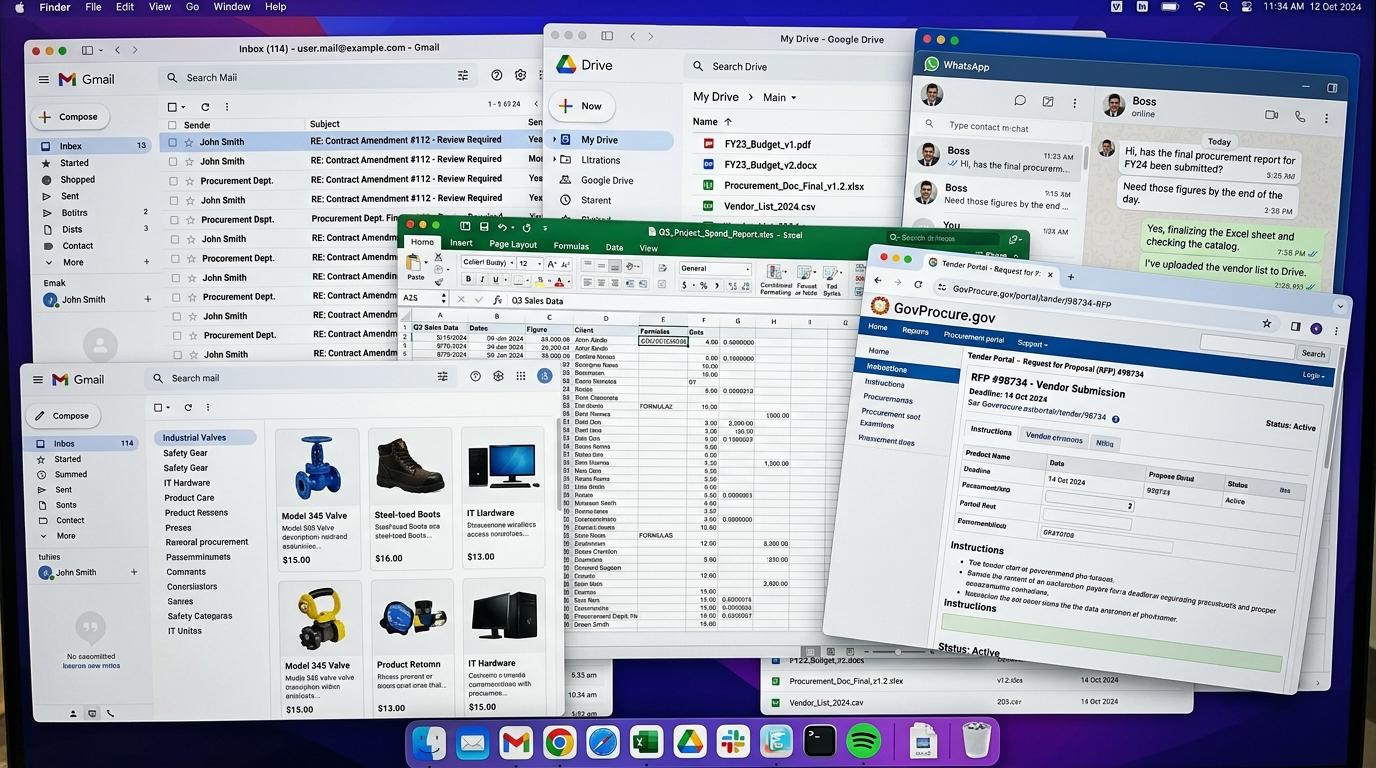
A desktop with many open windows — Excel, email, Google Drive, and a procurement portal

Several files that are supposed to be the same, but aren't

A master catalog, a separate file for every client, a separate spreadsheet for suppliers — and every change to one of them has to be manually "propagated" to the rest. Over time the versions drift apart, without anyone noticing right away.

Empty cells that actually mean "someone just knows"

A price, a supplier, a deadline — missing from the spreadsheet because officially no one has recorded them. The answer exists only in one employee's head.

Mixed formats with no clear logic

Different currencies in one row, different units of measure in different files, different names for the same column in different spreadsheets — every comparison requires a manual "translation in your head" before it can go any further.

Test or outdated data, indistinguishable from the real thing

A row with the word "test", or a long-invalid entry sitting among real data — nothing in the file stops such rows from entering the process and throwing off a result, a report, or even a delivery.

Text that looks different but is the same thing (or the other way around)

Manual or literal text comparison misses matches that are obvious to a person but not to a simple text filter. The result: a product or client that exists in the system but can't be "found" when it's needed.

One file that everyone opens and everyone edits

There's no split between who sees what and who's allowed to touch what — the price discounts for one client are visible to anyone who opens the file, including people who shouldn't see them.

Only 1-2 people really know which file is "the truth" at any given moment

The structure has grown enough that it's no longer obvious to anyone else which version is current and which is outdated.

None of these problems are about "poor file upkeep." They're the natural result of a manual, unstructured process carrying more than it was ever designed to carry.

The solution

What changes when the process becomes software

The difference isn't "a nicer spreadsheet." The difference is structure instead of trusting the honor system.

smartbion — warehouse
$ smartbion sync --process "catalog"

✓ един източник на истината✓ input data validation✓ role-based access✓ real-time visibility
# no manual "propagating" between files
After — one place
smartbion — public tender

Delivery of medical consumables — University Hospital "Example" JSC

180 items
162 confirmed
148 won
142 300 BGN value

Hospital

Official name University Hospital "Example" JSC
Internal name Example

Terms

Criteria Price
Estimated value 250 000 BGN
Срок на договора 36 months
Closed lots Yes

Matches by status

Auto To review No match Manual

Files

Spec_final.xlsx today, 09:14
Delivery_notice.pdf 20.08.2026
Contract_draft.docx 19.08.2026

A single source of truth

Data lives in one place. A change in price, stock, or catalog is visible everywhere instantly — no manual "propagating" across copies and versions.

Automated data entry and matching

Instead of manually searching row by row through a spreadsheet of hundreds of items, the system recognizes matches even when the format or phrasing differs slightly — exactly where literal comparison in Excel trips up.

Validation of data on the way in

Instead of free text that accepts anything — including errors, test entries, and empty cells that later become "someone just knows."

Role-based access control

Instead of one file, visible and editable by everyone — each person sees and changes only what they're authorized to.

Growth without breaking

More clients, products, or locations doesn't mean more manual work or a higher risk of error — the system is designed to carry volume, unlike a file that just keeps getting heavier and more unreliable.

Real-time visibility for management

Instead of separate files scattered across computers, from which no one has a complete picture of what's actually happening right now.

The investment

Why it's worth the investment

It's not just about tidier data. The change shows up in four concrete ways.

Better internal processes and productivity

Less manual work and fewer errors mean the team gets more done in the same time. Processes move on their own, instead of waiting for someone to manually push them forward.

Less workload on staff

Routine, repetitive tasks move to the system. People are freed up for work that actually requires judgment, instead of copying data between files.

Better customer-facing processes and more sales

Faster quotes, more accurate deadlines, fewer missed inquiries — when information lives in one place, the team responds faster to every client and misses fewer sales opportunities.

Higher customer satisfaction

Customers feel the difference when deadlines are met, prices are right the first time, and no one sends them wrong information because they were looking at an outdated file.

Do you recognize any of this in your business?

If so — you probably already know the solution won't come from "a tidier spreadsheet." Tell us exactly what your process looks like — we'd be glad to show you what it looks like once it becomes structured, not just a bigger file.